Sunday, February 14, 2016

Chocolate Conundrum

Japan's got a sweet deal for men on Valentine's Day. Forget about choosing cards, fussing over flowers, or treating your date to dinner out. Here in Japan, it's all about gals giving the chocolate. The guys just relax and wait for the sweet treats to come their way. (Don't worry. The men will get their turn later.)

On February 14, ladies get the murky duty of judging where they stand in their relationships, and giving accordingly.

First, there's the "giri choco" or "obligation chocolate." This is an inexpensive bag of sweets that you give to the guys around because you must. It's expected. It's a way of "greasing the skids" of the relationships in life. All of them. Well, mostly. Just don't get caught not giving to someone!

Then there's "honmei choco" or "favorite chocolate." These you only give to guys you want to show your affection toward. These sweets tend to be rather expensive, and probably even homemade.

Oh, yes! There's the "tomo choco" or "just friends chocolate" as well. That's a whole other category of relationship to figure out.

With all this chocolate swirling about, you'd think the guys would be thrilled. Not really. Getting chocolates comes with a whole set of obligations. Men must reciprocate on "White Day," a month later on March 14. Each and every chocolate needs to be responded to, often with one worth three times as much as received. Talk about putting on the pressure!

No doubt about it. In spite of all the heartshaped boxes, Valentine's Day in Japan is less about love, and more about duty and obligation.

Japan, if all this makes you yearn for a true unfettered expression of love, forget about the chocolate thing. Look to the cross of Christ instead. Here is a love given out generously to all − without levels, obligations, or payments still owed. John 4:10 says "This is love: not that we loved God, but that he loved us and sent his Son as an atoning sacrifice for our sins."

Now that's a sweet deal! Obligation chocolate? Nah! I'll take unmerited love.

Tuesday, December 8, 2015

When it Comes to Christmas, Japan "Takes the Cake"

When Japanese in Tokyo dream of a “white” Christmas, it can only be made of cream frosting...over yellow sponge cake...with red strawberries on top. For Japanese, strawberry shortcake is the essence of Christmas. Here in Kawasaki, the Christmas cake order forms from local bakeries fill our mailbox from late October. For those who dislike the long December 24th pickup lines, home delivery is possible. Tiny brand name shortcakes can set you back $50 or more!

Blame it on Western influence. It’s said that the founder of Fujiya Food Service, Fujii Rinemon, first got the idea during a Christmas visit to the States in the 1920’s. Fujiya has sold the Christmas cakes ever since, although it’s only been the last 20 years when they fully took root in Japan’s Christmas psyche. Now, 75% of Japanese say they must eat Christmas cake!

Just think...if Fujii had visited a church instead of a cake shop, the Christmas story might be very different in Japan today. Missionaries like me often wonder why Japanese find the cake to be so compelling of a Christmas image, while the baby Jesus is so foreign (I challenge you to come and find Christ anywhere at Christmas in Kawasaki).

Japanese have long been eager adopters. They pick and choose from other cultures those elements they enjoy, and discard the rest. But who would discard the baby Jesus for cheap white frosting? If only Japanese knew the real value of each. But then again, do we? American Christmas values may not be so far behind the white frosting of secular Japan. Unless we decide differently.

My Christmas dream is that nativity sets will replace shortcake as Japan’s new Christmas craze. My prayer is that you and I, too, will treasure the baby Christ much more than just the “frosted” fun this Christmas.

Thursday, August 6, 2015

Relearning Holiday Celebrations

July 4th went by without a single boom or bang. No hotdogs or patriotic concerts. Can you imagine July without a fireworks show? What about Labor Day without BBQ, backyard or beach? Or Thanksgiving without turkey or family gatherings? Something would be missing, wouldn’t it? What if Christmas or Easter weren’t even holidays? This is life in Japan. Yes, it does feel incomplete at times to this expat.

True, Japan has its own holidays. But to be honest, many of them lack appeal to me. I know I could probably learn a few things from Japan’s “Respect for the Aged Day” and “Physical Fitness Day.” But many holidays like “Sea Day,” “Mountain Day” and “Setsubun” (google it) have distinct Shinto values and make poor substitutes. And don’t get me started on Japan’s swapping of the Baby Jesus’ birthday with the emperor’s birthday in late December. That’s no celebration!

So, after 16 years here, we recognize that some things will remain a loss in our lives. I (Kevin) probably mourn this loss more than Kaori or Justen, both raised in Japan. But just when I start to feel like a martyr by settling for the skinny Japanese porkdog, in a top-cut bun, with the seaweed sprinkles and the horseradish mustard that clears my nose, I sense God asking, “How long will you mourn these small losses, Kevin? Whose kingdom’s celebration are you living for?” And I remember that I’m not at home in this world anyway, and look toward the eternal celebrations out of this world. Thank you, Lord, for good things to come!

(But next time we’re in the States, treat me to a decent Chicago hotdog.)

Saturday, April 4, 2015

The Rescue of Love (A Good Friday Meditation)

The pair of Japanese hostages are forever linked in our minds. We saw them in orange jumpsuits kneeling together in the Syrian desert sand. Behind them loomed a masked militant demanding a ransom in exchange for their lives. Tense days followed. Desperate negotiations and pleas for mercy. And then came the dreaded news of their horrific murders at the hands of their captors. Japan and the world were shocked and outraged.

But you might have missed the rest of their linked story. Kenji Goto and Haruna Yukawa were bound together far before their joint captivity. Yet the paths that led them to each other could not have been more different. One made a life in the midst of trouble. The other had a troubled life.

In Kenji, we see a glimpse of Christ’s love. Kenji was a Christian. (This in itself is remarkable considering the small number of Japanese believers.) As a journalist, he traveled to war-torn places to highlight the plight of persecuted groups and displaced refugees. He championed the cause of the weak and helpless, people in crisis and conflict who needed rescue from their circumstances. Kenji’s pastor stated that his Christian convictions influenced this selfless work.

Haruna was a very different man. If Kenji was a picture of Christ, Haruna was an apt picture of the world, mankind deformed by sin. Haruna was wounded deeply by life in ways that twisted his personality. A string of setbacks, including bankruptcy and the death of his wife, had damaged his psyche. He supposed himself to be a reincarnated Manchu princess. He became obsessed with right-wing nationalism and weaponry. His unstable behaviors ranged from suicide attempts to high-adrenalin risks. He had entered Syria for the self-motivated purpose of using the instability of the region to sell security services. Haruna clearly needed a rescue from himself.

Haruna’s rescue began when he met Kenji. In Kenji, Haruna found a friend who overlooked his faults and peculiarities, and cared for him even to the point of jeopardizing his own life.

When Haruna was first captured by the Free Syrian Army in March of 2014, Kenji was called by his contacts to help question this Japanese prisoner. Instead, Kenji was able to negotiate his release. The two returned to Japan together. In October 2014, Haruna returned to Syria and stumbled into trouble again. This time he was nabbed by ISIS. Kenji went after his hapless friend in a quest that resulted in his own capture. The rest of their fateful story together played out in media reports worldwide.

If Kenji is a picture of Christ, and Haruna a picture of the world, it’s not hard to see the gospel parallels in this story. Kenji determined to bring his wayward friend home. Christ came to seek and save his wayward people, and bring them safely home. Kenji looked past his twisted friend’s oddities. Christ’s divine love looked past the marred image of God to see the intrinsic worth of the soul. Kenji set aside his personal interests and risked his life to free his friend held hostage by militants. Christ set aside his deity and paid the ultimate price at Calvary to redeem mankind held hostage by Satan and sin.

If Haruna’s life had been spared by the sacrifice of Kenji, the redemptive illustration might have been complete. We wanted a different outcome for both of them. But what transpired in their final days of captivity together we may never know. Perhaps Kenji’s tender faith softened his heartless captors to consider the ways of Christ. Perhaps Kenji’s selfless testimony humbled Haruna to spiritual conviction. Perhaps the two safely returned to their true homeland of eternity in heaven together after all.

Heaven will tell their full story. This side of heaven, we can let their story inspire our own. We can drink in deeply that selfless, pursuing divine love that gives itself for selfish, wayward man. The cross shouts to us that we are loved more than we can know or understand. We can let that love motivate us into selfless ambition for our fellow man. Our own divine rescue of love constrains us.

“This is love: not that we loved God, but that he loved us and sent his Son as an atoning sacrifice for our sins. Dear friends, since God so loved us, we also ought to love one another.” 1 John 4:10-11

Tuesday, December 23, 2014

The Blue Light has Come?

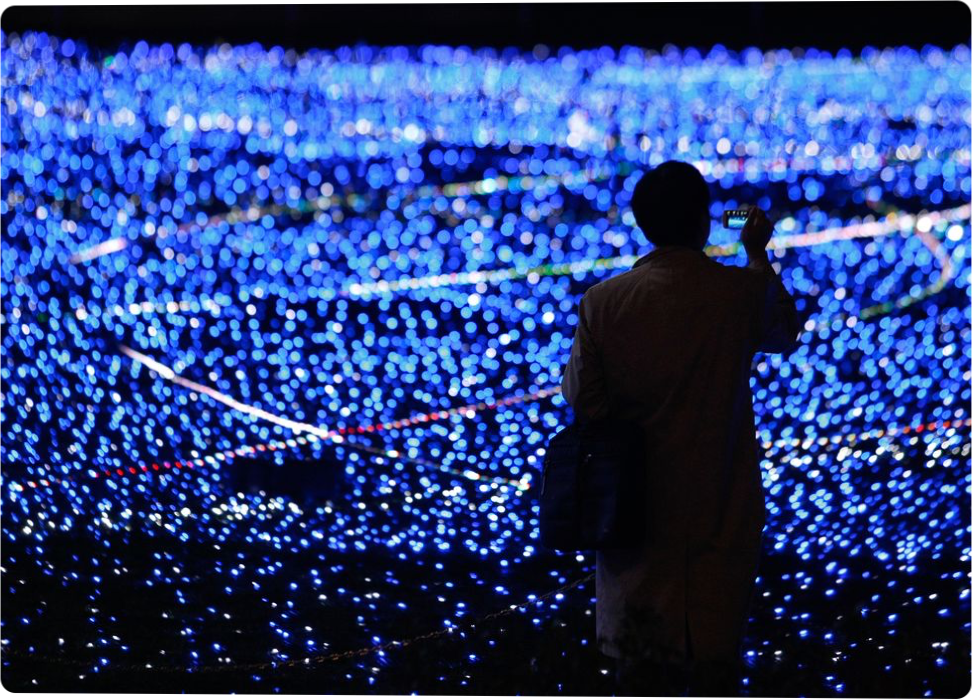
This Christmas, Japan is aglow with big news. Big BLUE news. Three brilliant Japanese physicists, Hiroshi Amano, Isamu Akasaki and Shuji Nakamura, have been awarded a Nobel prize for their creation of the blue light-emitting diode (LED), a key to energy-efficient white light. Twinkling blue light displays throughout Tokyo commemorate the occasion. The faces of the three are splashed across media outlets. Interviews and guest appearances abound. The emperor confers a national award in a special ceremony at the Imperial Palace. Everyone who is anyone attends the galas. The people of Japan are celebrating the gift of light! The Nobel Prize committee declared, "This LED holds great promise...to increase the quality of life for billions of people."

The blue light has come? Big deal. The TRUE LIGHT has already come! It's Christ that truly "holds great promise to increase the quality of life for billions of people." Yet the arrival of our Savior was met with so little fanfare. No national awards. No invitation to the palace. No photo opps. No fan letters. No glitzy festivities. The only special invited guests were a stable of animals and some outcast shepherds.

And so it is up to us today, the people of the cross, to CELEBRATE the gift of Light. Just think! The Light of the World has dawned...for you! The illumining work of his Spirit flooded your darkened mind. God rescued you from the kingdom of darkness and made you a citizen of the kingdom of light. Your gloomy tomorrows were swept away by brilliant hope. There's no more need for groping along the dark alleys of life; now divine guidance lights your way. And the ominous shadow of death has been driven off by glorious resurrection hope. The dawn of TRUE LIGHT in our world and your life is cause for great celebration. So enjoy your Christmas!

And while celebrating, remember it's also up to us to SHARE this gift of Light. Nations and peoples are still "walking in darkness" (Isa 9:2). In Japan it adds up to more than 99% of the population.

There's a tinge of irony in Japan becoming a Nobel laureate for illumination. One also wonders why, in this spiritually dark country, the people are increasingly enraptured by massive seasonal light displays. Can it be that the Japanese are searching and fumbling through the darkness for a TRUE LIGHT that the Spirit whispers to them about? Already in the dark corners of Kawasaki, Japan, that True Light has dawned. In 2014, darkness fell just a little bit more in our corner of the world as people responded by faith in Christ to God's call on their heart. Together with you, we push back the darkness inch by inch. We proclaim the "Light of the World" with all the strength and capacity God gives. We claim the promise of Isaiah 51:4 that "nations will come to your light, and kings to the brightness of your dawn."

Blue LEDs? They might change something somewhere perhaps. But the TRUE LIGHT of the world? He'll change everything for sure! Let's celebrate Him. Let's share him. Merry Christmas!

Tuesday, November 11, 2014

A Church Without Doors

There's a church without doors in Miyako, Japan. We've seen it for ourselves! The love of Christ spills out of the building and into the community.

"Up until the 311 tragedy, most Japanese didn't even know a Christian. They didn't feel anything toward the church or Christianity period!" says a Miyako Community Church member when I asked her about the impact of the ongoing relief work. "The tsunami changed things. Now, many people around here can say they know a Christian!"

Our team of six from our church plant, Denen Grace Chapel, again worked in the tsunami-struck area for a weekend last month, and can testify to Mrs S's words. Now, through the work of literally hundreds of Christian volunteer relief workers, many understand what Christianity is about: a neighbor there in their time of need with God's words and hands of hope.