Showing posts with label Culture. Show all posts

Friday, August 24, 2018

Japanese Puzzler


Here’s a JAPANESE PUZZLE BOX for you:

(brought to you by the space constraints of urban Japan.)

We returned back in Kawasaki to a completely dead car. It turns out that power locks don’t open without marginal battery power. But without being able to unlock the car, there is no way to open the hood and recharge the battery. WHAT TO DO?

Use the hideaway key in the key fob to open a manual lock door, you say? Ah, but herein is the best part of the puzzle! We need to park in our carport all the way over against the driver’s side door (the only side with a key hole) to have enough space to get out on the passenger side. 

The way the car is parked, there isn’t even adequate room to get the shaft of the key into the lock. No access. No open hood. No battery recharge. No driving.

WHAT WOULD YOU DO NOW?

SOLUTION: I broke down and called JAF (Japan Auto Federation). Things looked pretty grim for the first 30 minutes or so as the tech walked around and puzzled over it. He smiled when I suggested getting some sumo buddies to lift and move the car over. 

Then he struck upon an idea. From below he accessed some part with an electrical connection, and gave it just enough of an electric boost to open the doors. The hood was next. Then the battery jump. JAF really earned my membership fee this year.

Before leaving, in true Japanese fashion, he complimented me a few times on how well I parked. I interpreted this Japanese politeness as intended: "Don't park so stinking close to the wall on the key hole side next time!" We'll see how that goes. I might have to skinny down with Weight Watchers to get out of my car after this.

Monday, January 1, 2018

A "Barky" New Year?

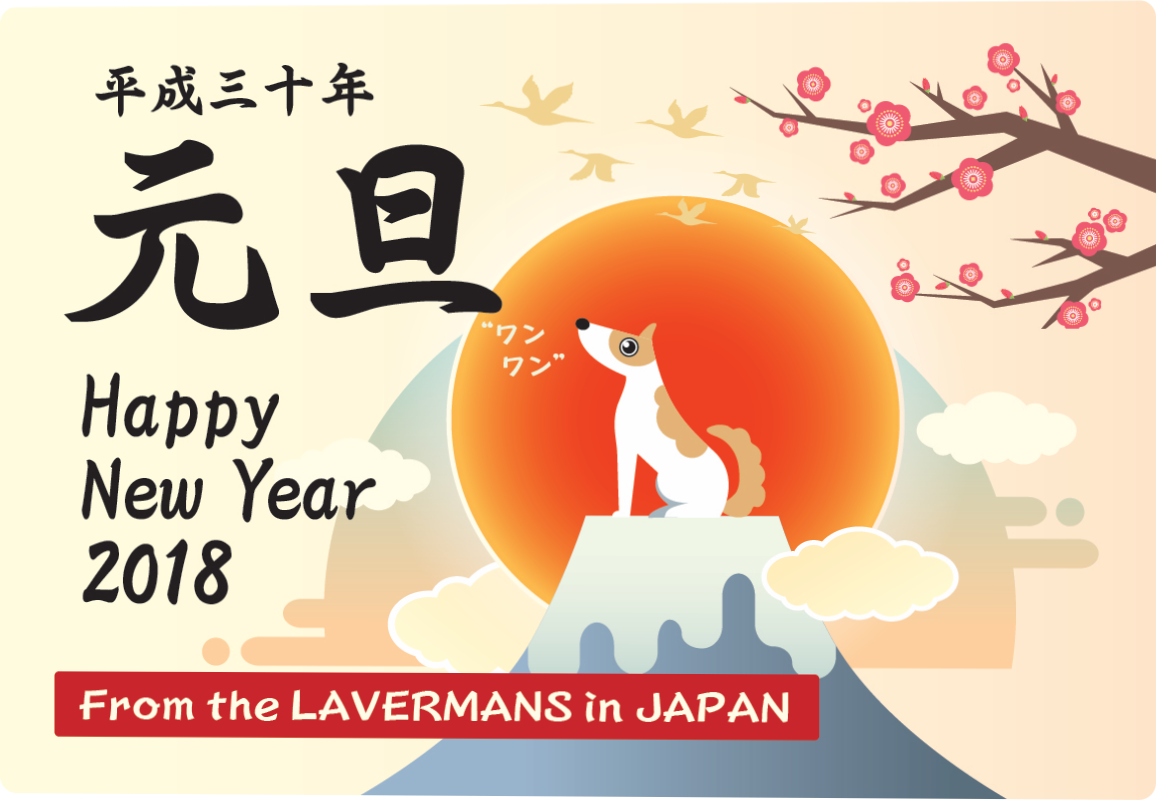
Wan Wan!    

Ah, 2018. The year has only begun and it's already going to the dogs!


Today, January 1st  (1/1), can be pronounced “wan-wan” in Japanese. “Wan-wan” happens to be the way that dogs bark in Japan. (And all this time you thought they said “woof-woof,” right?)

Perhaps it’s appropriate that the year begins with a couple barks. After all, 2018 is the Year of the Dog in the Chinese (& Japanese) zodiac. Japan knows how to market this idea. Dog-themed ads, products, foods, stamps and greeting cards are everywhere. And our local pet shop has a great discount on Shih Tzus (while supplies last) this first week of the year.

But wait! Is it really THE YEAR OF THE DOG? 
The Bible says that it’s actually “THE YEAR OF THE LORD’S FAVOR”


v18 "The Spirit of the Lord is on me, because he has anointed me to preach good news to the poor. He has sent me to proclaim freedom for the prisoners and recovery of sight for the blind, to release the oppressed, 

v19 to proclaim the year of the Lord's favor."    Luke 4


Jesus, quoting from Isaiah 61, pointed to the fulfillment of the prophecy in himself. Because of Christmas. Because he came. This would now be a favorable year! Jesus was not referring to a calendar year of 365 days, but an era of time during which man can be redeemed by His work at Calvary’s cross. This year, 2018, and every year until the rapture of the church, is an era and year of God’s favor! It is a year of possible forgiveness in Christ, and hope for this life and eternal life to come!

But how many Japanese will know that 2018 is anything but the year of the dog? Frankly, very few. In fact, 99.5% percent have no idea. We have to tell them the year can very different!

While it is still the year of the Lord’s favor, and before this era of time comes to an end, we are all entrusted with good news to share with our world. Kaori and I believe God would have us to preach this good news and “proclaim the year of God’s favor” in Japan. It is this conviction that moves us forward here in the year ahead of challenges and blessings.

So, thank you for sending and supporting us in this work! Your confidence in God to work through us in Japan is encouraging and humbling!

If you would like to become a support partner with us in 2018, it’s really easy to do, and it’s a really critical time for us in our start of Vision 2020. In 2018, we’d like to be fully supported again for this work. We’re making progress, but still need monthly commitments. Click here to begin, or here for more details. Pass this along.

God bless you in 2018, this year of His favor for the world. Happy New Year!


Kevin & Kaori Laverman


P.S. Cats really rule as pets in Japan. (And wait until you hear what they say in Japanese. Hint: ニャーニャー)

Monday, April 10, 2017

The End of Endings


Jesus said, “I am the resurrection and the life. He who believes in me will live, even though he dies; and whoever lives and believes in me will never die.” John 11:25-26


This time of year, people all across Japan walk about in awe under giant canopies of soft pink. It’s cherry blossom time!

Many view the blossoms simply as nature’s beautiful spring show. Others view metaphor: cherry blossoms are a boundary marker in the seasons of life. They’re a reminder that our lives, too, are fragile and fleeting. For the samurai, fallen cherry blossom petals symbolized a fallen warrior. Their lives bloomed and fell in glory for their lord.

Regardless of how you view the cherry blossoms, one thing is sure: their brilliance comes to a quick end.

Good Friday and Easter should turn our view upside down. The metaphor is reversed. It is not the samurai who sacrifices his life for his lord. Rather, the lord sacrifices for his servants. On Good Friday, Christ, our Lord, sacrifices for us. At the cross, he throws his life away in sacrifice. He is like the fallen petal. But only a single one need fall to its end. Christ dies in the place of us all.

Now, the clock turns backward. Can you imagine falling cherry blossom petals suddenly reattaching themselves to the tree, their source of life, and going onto full and beautiful existence? This is what Christ has done for us. At the cross, he died. At the grave on Easter, he defeated death. We who believe in him are reattached to the source of true life. God, the Holy Spirit, now dwells inside. Divine, eternal life has fused itself into us.

No longer must “cherry petals” flutter in mass toward the ground. No, for in Christ, our forever end is averted. True spiritual life begins. Our brief lives can be lived in without the pathos of transience and ending. Our lives can be lived with the blessed hope of eternity to come. Why? Because we know that the end of this season on earth, is but a more glorious flowering of life in heaven to come.
Christ’s death has reversed the curse of endings. Glorious life begins. Let’s give thanks to as we celebrate Good Friday and Easter.

Sunday, February 14, 2016

Chocolate Conundrum

Japan's got a sweet deal for men on Valentine's Day. Forget about choosing cards, fussing over flowers, or treating your date to dinner out. Here in Japan, it's all about gals giving the chocolate. The guys just relax and wait for the sweet treats to come their way. (Don't worry. The men will get their turn later.)

On February 14, ladies get the murky duty of judging where they stand in their relationships, and giving accordingly.

First, there's the "giri choco" or "obligation chocolate." This is an inexpensive bag of sweets that you give to the guys around because you must. It's expected. It's a way of "greasing the skids" of the relationships in life. All of them. Well, mostly. Just don't get caught not giving to someone!

Then there's "honmei choco" or "favorite chocolate." These you only give to guys you want to show your affection toward. These sweets tend to be rather expensive, and probably even homemade.

Oh, yes! There's the "tomo choco" or "just friends chocolate" as well. That's a whole other category of relationship to figure out.

With all this chocolate swirling about, you'd think the guys would be thrilled. Not really. Getting chocolates comes with a whole set of obligations. Men must reciprocate on "White Day," a month later on March 14. Each and every chocolate needs to be responded to, often with one worth three times as much as received. Talk about putting on the pressure!

No doubt about it. In spite of all the heartshaped boxes, Valentine's Day in Japan is less about love, and more about duty and obligation.

Japan, if all this makes you yearn for a true unfettered expression of love, forget about the chocolate thing. Look to the cross of Christ instead. Here is a love given out generously to all − without levels, obligations, or payments still owed. John 4:10 says "This is love: not that we loved God, but that he loved us and sent his Son as an atoning sacrifice for our sins."

Now that's a sweet deal! Obligation chocolate? Nah! I'll take unmerited love.

Tuesday, December 24, 2013

Christmas is all about KFC

Japan spells Christmas with three "finger-lickin' good" letters: K-F-C. Move over sushi and wasabi, fried chicken is the main course on Tokyo tables at Christmastime.

The roots of this craze go back four decades. On a Christmas day in the early 1970's, foreigners in Japan flooded the newly-opened KFCs, gobbling up the colonel's best recipe. It was a poor substitute for the visions of golden-brown turkeys that danced in their heads, but it was the only crispy bird to be had around. A shrewd KFC manager watching the foreigner stampede saw yen signs. In 1974, the company presented its first Christmas meal: chicken and wine for $10. It sold well in spite of being costly for its time.

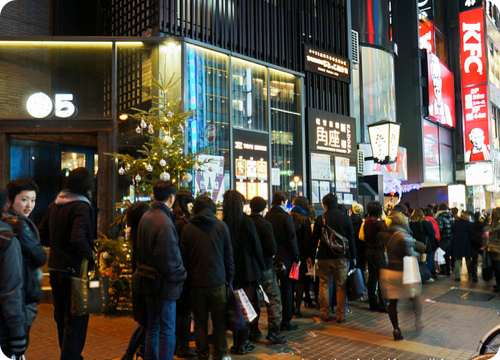
Today, a family bucket will set you back $40. Still, the Christmas fried chicken fad has taken root in a big way in Japan. A quarter million buckets (or boxes) of chicken will be sold on Christmas day alone. A savvy marketing blitz helps. Weeks ahead of time, a flurry of coupons fill mailboxes of urban homes. TV ads feature Japanese children in Santa hats (and with KFC barrels in hand) dancing about to catchy jingles. Even the revered statue of the colonel in front of KFC stores gets dressed up in a Santa suit (somehow it fits his mystique). Stores take orders four weeks in advance. Long lines form early on Christmas eve to pick up the crispy parcels. KFC has become the go-to meal at Christmastime.

Colonel Sanders would roll over in his grave if he knew that KFC has become the focus of Christmas in Japan. You see, he became a born-again Christian late in life. He knew the focus of the celebration was Christ. We do, too. Right?

I've missed a few Christmases in America. Christmas 2013 is our first in 10 years. And I've come to a conclusion after spending Christmas in Japan for awhile and now being home on furlough. I don't know whether it's really true that "Nobody does chicken like KFC." But it's definitely true that "Nobody does Christmas like America." The music and concerts, the lights and decorations, the get-togethers and endless food, the TV specials and store sales...the celebration runs the gamut from dreamy and reflective, to bustling and hectic, to grand and breathtaking. We know how to do Christmas! But we also know how to lose our focus in the whole celebration.

It turns out that Christmas really is all about KFC. That is, Keeping the Focus on Christ. Time with family and friends, twinkling decorations, tasty food, thoughtful gifts are all wonderful trimmings. But we lose out on the main course if we miss worshipping the One whose birthday celebration it really is.

When it comes to Christmas, it might be too much to ask that America would simply scale it back, tone it down, or turn some of it off. Simpler celebration doesn't seem to fit our bigger and better sensibilities. But at the very least we can individually take time to simply worship him. 1 Peter 3:15 says, "But in your hearts sanctify him as Lord." In the middle of it all, choose things that will draw you into worship of Him. And choose to see the rest in a new worshipful way. Choose to let the light displays remind you of the Light of the World who came and "gives light to every man" (Jn 1:9). Choose to let the table spread with food remind you of the Bread of Life who came and "gives life to the world" (Jn 6:33). And, of course, choose to let the presents (however quirky they may be) remind you of the "indescribable gift" (2 Co 9:15) who came to give forgiveness and cleansing, adoption into God's family, a place in eternity, and he himself to us.

Let the things of Christmas amplify and not distract your worship of Him. KFC. Keep the Focus on Christ. And that's what will really make Christmas "so good!" (KFC pun intended)

P.S. — Anyone want some Japanese KFC coupons?

Sunday, January 13, 2013

New Year House Shopping

I'll never forget that sensible question. It was uttered by a little boy wandering about in the same aisle as me in our local home center around new year's day. His mom was right there next to him, keeping him busy while his father, no doubt, was checking out the power tool sales. The boy took inventory of everything about him, touching and monkeying with whatever was within his reach. Then he abruptly stopped, looked curiously at an item up high, pointed, and asked mom, "What's that?" He'd probably never seen a housing for a deity that Japanese typically use to decorate a kamidana, or god shelf, in their homes. This particular one was on sale.

His mom followed his finger to the do-it-yourself kit (roughly the size of a loaf of bread), and said, "Oh. Well, that's a house for god." The boy's response was priceless. He wrinkled up his face quizzically and said, "A house for god? Why would god need a house? That's dumb." From the mouths of babes! His mom was completely nonplussed. She darted a sheepish glance at me before scurrying the boy along.

Why limit the divine to a tiny decoration? How have we limited God in convoluted ways within our own faith? Perhaps not in the way of a do-it-yourself kit, but to greater degrees than we recognize and admit. A missionary colleague here in Japan wrote a piece on this subject and the Japanese New Year traditions. The original article is here. I have included it below. Enjoy, think and pray!

Thursday, December 13, 2012

Joy to the World


It was right there on our mall store window. For most Japanese passers by, it was meaningless decorative lettering. But in a world where the sacred and secular rarely meet, the presence of these words spun me in my steps. What's more, this is Japan! You won't find talk or sight of the Lord Jesus ANYWHERE at Christmas time. My unofficial poll numbers show a 99% ignorance level concerning Christmas day. If pressed, Japanese kids will adamantly insist that December 25th is the day that Santa was born (or died).

But then I spotted it. On another sign immediately below "the Lord is come" on a rack of winter clothing styles was posted "New Arrival" (see yellow arrow above; click to enlarge). The juxtaposition of these signs made me grin. "This storefront could start another cult," I laughed. But after reflecting a moment, I decided to take the words as a bit of prophetic hope for Japan. Some 2000 years this side of the first arrival of Christ, the Spirit of Christ does come again and again to Japan, convicting this nation of sin, righteousness and judgement. And every heart that opens to him from stylish Tokyo to 311-struck Tohoku experiences a brand "new arrival" from the Ancient of Days. We missionaries dream of the day Jesus will be the new style in Japan.

Our prayer this Christmas is that many Japanese will experience the "new arrival" of Christ into their hearts and lives! Please pray along with us and for us. 

Tuesday, October 23, 2012

Jesus Rocks in Aomori, Japan

Many people in northern Aomori, Japan have discovered that Jesus really is a rock (not the Rock, unfortunately).

It seems that a recently discovered rock formation in a hidden alcove along Lake Towada roughly resembles the silhouette of Jesus. Hundreds of tourists are boarding boats to take a closer look. A YouTube video describes the scene.

The name of the lake begins with a Japanese letter that looks like a cross (十和田湖). That coincidental spelling bolsters the idea in the mind of some tourists that this rock is indeed religiously significant. Some have even suggested that this may have been a site of worship for Japan's hidden Christians during the brutal 16th century persecution.

Monday, September 24, 2012

The Feudal Christian "Rebel"

Juan Goto (1586?) was born Matagoro Iwabuchi, the son of the lord of Fujisawa Castle in northern Higashi-Iwai, Iwate prefecture. He lived during a time of great political instability. His own family was caught up in a power struggle when Great Lord Kasai was accused of not rallying troops for the Battle of Odawara. During this battle, Juan's older brother was killed. This loss, in addition to the political struggles about him, may have contributed to Matagoro's next actions.

Something seems to have snapped in Matagoro that caused him to want to "get away from it all." He fled across country to the far southern city of Nagasaki. This cross-country journey of some 1200 miles was a remarkable feat in itself in his day. From Nagasaki he boarded a vessel that landed him in Ukujima Island of the Goto Islands chain (map). This was as far away as he could get from his homeland and still be in Japan. It reveals, perhaps, a bit of his despair and desperation.

Monday, August 13, 2012

Superstition & Mission (Part 2)

It turns out dad got it wrong. Money does "grow on trees." Just look at the photo at left as proof! Recently while hiking down a mountain past a buddhist temple, I stumbled across several of these trees with trunks stuck full of coins. I had seen this elsewhere, but not to this degree. It is the Asian equivalent, I suppose, of the "wishing well" or fountain of pennies one might come across in a Stateside mall. No harm done by these innocent superstitions, right?

For Japanese, however, such superstitions have permeated (and control) daily life. Japanese readily admit their Shinto polytheistic belief in "millions of gods" (yaoyorozu no kami) present in creation. Buddhist and Taoist gods were even brought over and absorbed into their belief structure. These gods are given to whimsy and must be sought out for blessing and good luck. Punishment and bad luck are just as likely. A whole ecosystem of superstitions are formed to guide one in how to receive or avoid such.

Friday, July 20, 2012

Superstition & Mission (Part 1)

Put a broiled fishhead in your entryway. Pile salt just outside your front door. Avoid cutting your fingernails after dark. Paint your house neon yellow. Do not whistle at night. What do all these odd actions/non-actions have in common? They are ways to ward off bad luck in Japan.

Japan is filled with such superstitions. While some are modern urban legends, many come from the animistic roots of Japan's religious beliefs. The many (millions of) gods and evil spirits in nature are capricious and mischievous. They must be appeased or driven away lest they bring death or misfortune to oneself.

Many superstitions surround the fear of death and suffering. The numbers four and nine are unlucky because they are pronounced in the same way as death (shi) and suffering (ku). Hospitals avoid the use of these numbers for rooms and floors. You'll also never find a set of four dishes in Japan. Plateware comes in sets of three or five.

Thursday, June 28, 2012

Signs of the Times?

A drive through Japan's rural towns throughout the north might lead the casual observer to assume these places are staunchly Christian. Why else would signs everywhere proclaim such things as "The blood of Christ purifies sin," "God is watching your heart," and "The wages of sin is death"? But the truth is quite the opposite. In many of these rural areas one would be hard-pressed to find more than a solitary Christian, much less any church presence.

The signs are lettered in white and yellow calligraphy against a black background. Once they are up, they can remain for decades on end until the structure they are attached to literally begins to crumble. These signs, called "Kirisuto Kanban" (Christ signs), are the work of Christian group called the Bible Distribution Society, founded by a missionary in the 50's and now active only as a loose network of a few people.

Thursday, May 3, 2012

Life Worth Little in Wealthy Japan

Sobering news out of Tokyo today. The Cabinet Office reported results of a survey that 1 out of 4 Japanese has considered suicide. Yes, 25% of Japanese think of killing themselves. For the last dozen years, Japan has trended toward a higher and higher rate of suicide, surpassing 30,000 cases every year. That's one person every 15 minutes! Many are group suicides. Japan's suicide rate is nearly triple that of the USA! Countless cases go unreported because of the family shame factor involved.

Tuesday, April 3, 2012

Jesus Buried in Japan?

Absolutely not! But the rumor, as outrageous as it seems, has become the center of a local attraction in the village of Shingo, Aomori Prefecture. The legend here is that Jesus traveled to Japan when he was a youth and learned Japanese ways and customs. He later returned to Israel in his 30's where his teaching was rejected. Before the Romans could crucify him, his identical twin brother Isukiri snuk in and "casually took his place on the cross" [so says the sign at the location]. Afterwards, Jesus returned to Japan and spent his life in Shingo as a rice farmer. He lived until 106, raising a family and doing good deeds locally. He was buried in the Shingo village where a mound with a cross marks his grave.

Saturday, October 15, 2011

Merry Halloween?

It doesn't take long in Japan to discover that many holidays have crossed the ocean. One also soon discovers that the way these holidays are celebrated is very different than one's own experience. Japanese tend to be very eclectic, adopting a variety of styles, tastes and customs from many cultures, but always adapting them to suit their unique tastes. Borrowed holidays are a pretty "mixed up" affair here. 

This American foreigner was intrigued to discover that Japanese turned Valentine's day into two separate events in February and March, one for boys and another for girls. Christmas has nothing to do with the birth of Christ. And the Christmas cake, not ham or turkey, is the main eating attraction.

Several years ago Halloween began to become more popular in Japan. While I have mixed feelings about this holiday coming to Japan, it brings a flavor of home to see pumpkins and fall decor in stores. But I have to draw the line at the new greeting this year printed on Halloween goods and decorations everywhere: "Merry Halloween." I hope it is a one-year anomaly coming from some confused supplier somewhere in Asia, but I have the feeling it's going to become a fixed part of the local vocab.

I can see where this mixed up holiday trend is going in Japan. So someday when a Japanese wishes you a "Happy Christmas" in a card with a picture of a Mickey Mouse cake on it, you will know where it started.

Wednesday, September 21, 2011

Can Japanese get their hope Bach?

Unintended missionary to Japan?
Who would have thought Bach would be involved in 21st century mission work in Japan? I have frequently read with interest of the strong connection between classical music (particularly J.S. Bach) and Japanese interest in Christianity. Japanese have great respect for beauty and culture, so this is no surprise. It seems God uses a variety of unusual evangelists and music genre to guide Japanese to himself. Gospel music, of course, is another boom. Read the following excerpt of a longer article available here:

No other country in the developed world keeps as many palm readers busy. None produces as much pornography; nearly half the worlds smut is made in Japan—and openly consumed in trains and subways. Suicide rates have risen from 23,000 in 1996 to 25,000 in 1997 and 32,000 in 1998. In that year, seventy–four children killed themselves in Tokyo alone, twice as many as in 1997. According to opinion polls, 60 percent of the population admit to being afraid every day. Most fear bringing shame on their families, teachers, or superiors by failing at work or in school.


“What people need in this situation is hope in the Christian sense of the word, but hope is an alien idea here,
” says the renowned organist Masaaki Suzuki, founder and conductor of the Bach Collegium Japan. He is the driving force behind the “Bach boom” sweeping Japan during its current period of spiritual impoverishment. “Our language does not even have an appropriate word for hope,” Suzuki says. “We either use ibo, meaning desire, or nozomi, which describes something unattainable.” After every one of the Bach Collegium’s performances Suzuki is crowded on the podium by non–Christian members of the audience who wish to talk to him about topics that are normally taboo in Japanese society—death, for example. “And then they inevitably ask me to explain to them what ‘hope’ means to Christians.”

Like Georg Christoph Biller, Leipzig’s current Thomaskantor and Bach’s sixteenth successor in that position, Suzuki sees himself as a missionary. 
“I am spreading Bach’s message, which is a biblical one,” he said, echoing the Swedish theologian and Lutheran archbishop Nathan Söderblom (1866–1931), who called Bach’s music “the fifth Gospel.” A member of the Reformed Church, Suzuki makes sure his musicians, mostly non–Christians, get that point. During rehearsals he teaches them Scripture. “It is impossible to say how many of my performers and listeners will ultimately become Christians, ” Suzuki said. He believes, however, that Bach has already converted tens of thousands of Japanese to the Christian faith.

Friday, July 22, 2011

Tsunami Stones

His family perished in the water along with hundreds of others. His beloved town was destroyed beyond recognition. His family home and grave markers were washed away. First the earthquake. Then the waves of water that crushed everything in their path. There was little warning of the tragedy that came ashore that day.

In the midst of his grief, the man desires that generations to come not endure the pain and sorrow that he is going through. They must be warned of the danger of tsunamis! They must not build homes along the shoreline! The man devises a warning system: a marker stone. The year is 1896. The Meiji-Sanriku tsunami has just killed 22,066 Japanese.

Hundreds of these stones are found along the coastline of Japan. Some are more than 600 years old. "High dwellings are the peace and harmony of our descendants,” one reads. "Remember the calamity of the great tsunamis," another stone warns. "Do not build any homes below this point,” an inscription on another stone advises.


In the bustle of modern Japan, many disregarded such good advice, building communities right along water's edge. Perhaps they took comfort in the sea walls built in the 1960's after a smaller tsunami. But in the town of Aneyoshi, a centuries-old stone saved the day. It was advice that a dozen or so households of Aneyoshi listened to carefully, and on March 11, 2011 their homes and lives were spared from a disaster that flattened low-lying towns all around.

A God that loves us infinitely and knows us completely desires that we be spared from personal disaster in this life. He desires that we be spared not from physical death, but from spiritual, emotional and relational death that poor choices and rejection of His ways can bring. His warnings are left for all generations to know and heed. The warnings in His Word are not raging outbursts from an angry God. His warnings are gracious love calls that say, "I am for you. I want you to enjoy everything I have to give you. Listen to my wisdom for your life."

"Today I am giving you a choice between prosperity and disaster, between life and death...Oh, that you would choose life, that you and your descendants might live." Deut. 30:15, 19 NLT

Wednesday, July 13, 2011

Uncool Hero

Another sign of the times in Japan: a new superhero has been born. With the Fukushima nuclear power plant down (melted down), and the mecury up, Japan is scrambling to find the extra energy it needs to avoid summer blackouts. Everyone is being urged to turn off or turn down unneeded electric.

Only in Japan would you find a superhero to champion the cause. Right out of the PR office of Tokyo's Power Company just in time for the peak summer heat comes: Energy Savings Man. He may look cool, but the advice he gives is anti-cool: TURN OFF YOUR A/C (Or, at least adjust the thermostat).

I'd like to say I am Energy Savings Man in our home, but it is Kaori who truly champions the cause. We fight over control of the A/C thermostat...it's going to be a long summer. These days, It turns out that it's COOL to be a little more UNCOOL in Japan.

Friday, July 8, 2011

No Second Opinions?

I was interested to see this hospital scene. That any doctor's opinion in highly vertical socially structured Japan is even questioned is a sign that, perhaps, things are changing a bit.

The Second Opinion window, however, is obviously not getting much business. After hours? Shut down by the doctor's union? Shut down for lack of inquiries? Japanese patients embarrassed to appear so brazen? Perhaps some combination of all of the above. Some things change more slowly in Japan. Somehow I doubt this will catch on fast.

Wednesday, February 9, 2011

"Nice try, Kevin" file

This one goes into the "Nice try, Kevin" file. I just thought it was a nice-looking bunch of flowers in the storefront and, on the spur of the moment, decided Kaori deserved to enjoy them. Chrysanthemums, however, are usually seen at Buddhist altars along with incense sticks and food morsels for the dead. It's sort of like giving your beloved a grave marker for their birthday. This was a point that Kaori reminded me of when I presented my well-intended gift.

If I had stopped to think about it long enough, I might have remembered that this variety is more associated with occasions of death, then times of joy. Navigating the cultural symbols correctly often gets me in trouble. After 12 years in Japan, my nice try, Kevin" file is pretty full.