There's a church without doors in Miyako, Japan. We've seen it for ourselves! The love of Christ spills out of the building and into the community.
"Up until the 311 tragedy, most Japanese didn't even know a Christian. They didn't feel anything toward the church or Christianity period!" says a Miyako Community Church member when I asked her about the impact of the ongoing relief work. "The tsunami changed things. Now, many people around here can say they know a Christian!"
Our team of six from our church plant, Denen Grace Chapel, again worked in the tsunami-struck area for a weekend last month, and can testify to Mrs S's words. Now, through the work of literally hundreds of Christian volunteer relief workers, many understand what Christianity is about: a neighbor there in their time of need with God's words and hands of hope.

Tuesday, November 11, 2014


Thursday, October 30, 2014
The 50th-Year Jubilee

Fukushima is hardly a place to celebrate. It’s ground zero for the 311 nuclear disaster. Radiation fears sparked a mass evacuation. Ghost towns abound. But on September 14th, the city became a festive place once again. The body of Christ gathered here for a special reason: our association of Baptist churches turned 50 years old, now with over 3800 members in 54 churches from Tohoku to Tokyo. It’s our year of jubilee! [Photo: our group from Denen Grace]
 As part of this 50th Anniversary Celebration, we broke the norms. Instead of the usual slate of speakers, we enjoyed a talent show from our member churches that included gospel music, karate, hula and handbells. All this was set in a Japanese quiz show format in which the audience was invited (with colored paper) to test their knowledge of our churches’ history [see photo at right]. Our own church plant was featured and one of our members even won top prize!
It was humbling to learn that many of our churches trace their roots back to American missionaries who came and planted seeds. Setbacks, language bloopers and cultural missteps? Yes! Plenty! “But God made it grow” (1 Cor 3:6). This group of 500 believers gathered in Fukushima are a testimony to God’s harvest work!
Friday, June 27, 2014
How Do You See the World?

That's what I nearly shouted when I first saw that image on TV many years ago. The popular Japanese cartoon's intro theme had panned out from a Tokyo house, to gradually show the surrounding city, area, country, and then the entire globe...with Japan squarely at the center! My home continent was nowhere in sight.
Doesn't every cartographer know that North America should be around the center? Maps just look balanced that way! Google "world map" images and you'll see that the USA is always center left, while Japan is at the far periphery. But wait! Google "world map" in Japanese (世界図) and a whole new set of "strange" images comes up. Japan is at the center. All continents are at the periphery.
East or West, it seems that wherever you call home, that becomes center of all things for you. The Chinese name for their country literally means "middle kingdom." This name emerged from Chinese philosophy that believed China to be in the center of the earth. Not to be outdone, the Japanese name for their country literally means "origin of the sun." In 607, Prince Shotoko of Japan began a letter to China with the less than politically-correct greeting: "From the sovereign of the land of the rising sun to the sovereign of the land of the setting sun." Diplomatic relations may have yet to recover.
Let's face it. This me-at-the-center-of-things thinking has permeated human history since Adam and Eve. And it's made a real mess the world over. Some call it ethnocentrism. Others call it national or ethnic pride. Still others call it geo-politics or socio-economics. But when this thinking takes over, the Bible calls it sin. Because such thinking takes glory away from the True Center.
"At the center, Christ rules the church." Eph 1:20 MSG
God sees the world differently. Man is not at the center. Nations and kingdoms are not at the center. Christ is at the center. And his kingdom is at the center. He is the absolute middle by which we are to look at our world. What results is this:
"Words like Jewish and non-Jewish, religious and irreligious, insider and outsider, uncivilized and uncouth, slave and free, mean nothing. From now on everyone is defined by Christ, everyone is included in Christ." Eph 3:11 MSG
God does not divide up the world along geographic, cultural, socio-economic, or racial lines. He sees people only in relation to himself and his Son, Jesus. His children are either found or still lost. They are a part of his Son's kingdom or still outside of it. It's that simple.
Looking at the world with God's eyes will drive mission work. When we humbly realize that none of us was or is at the true center, our task becomes clear. We must reach out to people on the spiritual periphery, wherever they are found, and point them toward the true center, Christ.
So how do you see the world?
Monday, June 9, 2014
Seasons of a Church Planter
The cherry blossoms are long gone. Scorching temperatures came in May. And now June begins the rainy season in Japan. Rain poncho and umbrella sales are booming. Seasons change. Even in the life of a church planter.
Although there's still much finishing work to do at Denen Grace Chapel, we've started to look toward to our next church planting work in the area. It won't be easy. But we're praying as a couple. We're communicating vision to Denen church members. We're trusting our Season Changer's guidance and provision. Would you pray with us, too, for the changes ahead?Even as seasons change for us in church work, sometimes we get a slice of several "seasons of church planting" at once (that happens in weather, too). Here's a snapshot of four seasons in the last few months.
How long and hard we've prayed and agonized over our church plant, Denen Grace Chapel! Yet Japanese Christians have prayed and agonized much longer and harder! I was reminded of this at our "Teamwork Meeting" in northern Japan. That's a gathering of our church association pastors and missionaries.
I was challenged anew by our early morning prayer time together. We prayed for Japan. I sat between a pastor weeping and another prostrate on the floor. For hundreds of years, in spite of the sweat of many workers and the blood of many marytrs, the Japanese have only responded in small numbers to the gospel. But we pray and wait. God is working under the surface.
The gospel plant grows best in native soil. So, over the years we've tried to incorporate Japanese culture into our church activities (while being careful to not compromise the gospel message). In this photo, our group of ladies are practicing the art of Japanese writing using Scripture verses. (see photos)
For many in this group, it's their first interaction with the Bible! Toward the end of class, our church member (standing in photo) shared a familiar Japanese rhyme used in writing exercises. Few Japanese know that it was created by the underground church (see website) during the martyrdom of the 17th century. The last letters of each line form the hidden acrostic: "Jesus died for me." That discovery brought some startled response from the ladies! Keep praying!
Recently while preaching at my wife's home church in Yamagata, I was struck by this photo on display there. It shows a tiny group of early church members (including my circled in-laws) surrounding the planting missionary, Joe Meeko. Fifty years later this church has multiplied many times over. It's won to Christ, discipled and sent out many, some even to foreign mission fields! And my life story intersects here, too. Without that missionary's evangelistic work, I might not be married to a Chrisitian woman named Kaori!
Mr. Meeko's faith and dedication was huge, but ultimately it was the work of God that brought my Yamagata family to Christ. I pray Denen Grace Chapel will be the same kind of dynamic, multiplying church here in Kawasaki in the years to come. If God chooses bring much fruit from this work, it won't be because of my ability. Make no mistake: "God gives the growth." (1 Cor 3:6)
Recently on Easter Sunday 2014, I did again what I sometimes do in church. I got out of my front seat and stood in the back. The view from the back is special. Seeing new Christians standing together and worshipping God draws me into deeper worship and thanks, too.
When the week of church planting has been hard, when setbacks seem to outnumber forward motion, when the cultural stress builds up, I like to remind myself of why I'm here. So I go to the back on a Sunday and take a good look. And God tells me, "Always give yourself fully to the work of the Lord [Kevin], because you know that your labor is not in vain." (1 Cor 15:58)
Although there's still much finishing work to do at Denen Grace Chapel, we've started to look toward to our next church planting work in the area. It won't be easy. But we're praying as a couple. We're communicating vision to Denen church members. We're trusting our Season Changer's guidance and provision. Would you pray with us, too, for the changes ahead?Even as seasons change for us in church work, sometimes we get a slice of several "seasons of church planting" at once (that happens in weather, too). Here's a snapshot of four seasons in the last few months.
 PRAYING
How long and hard we've prayed and agonized over our church plant, Denen Grace Chapel! Yet Japanese Christians have prayed and agonized much longer and harder! I was reminded of this at our "Teamwork Meeting" in northern Japan. That's a gathering of our church association pastors and missionaries.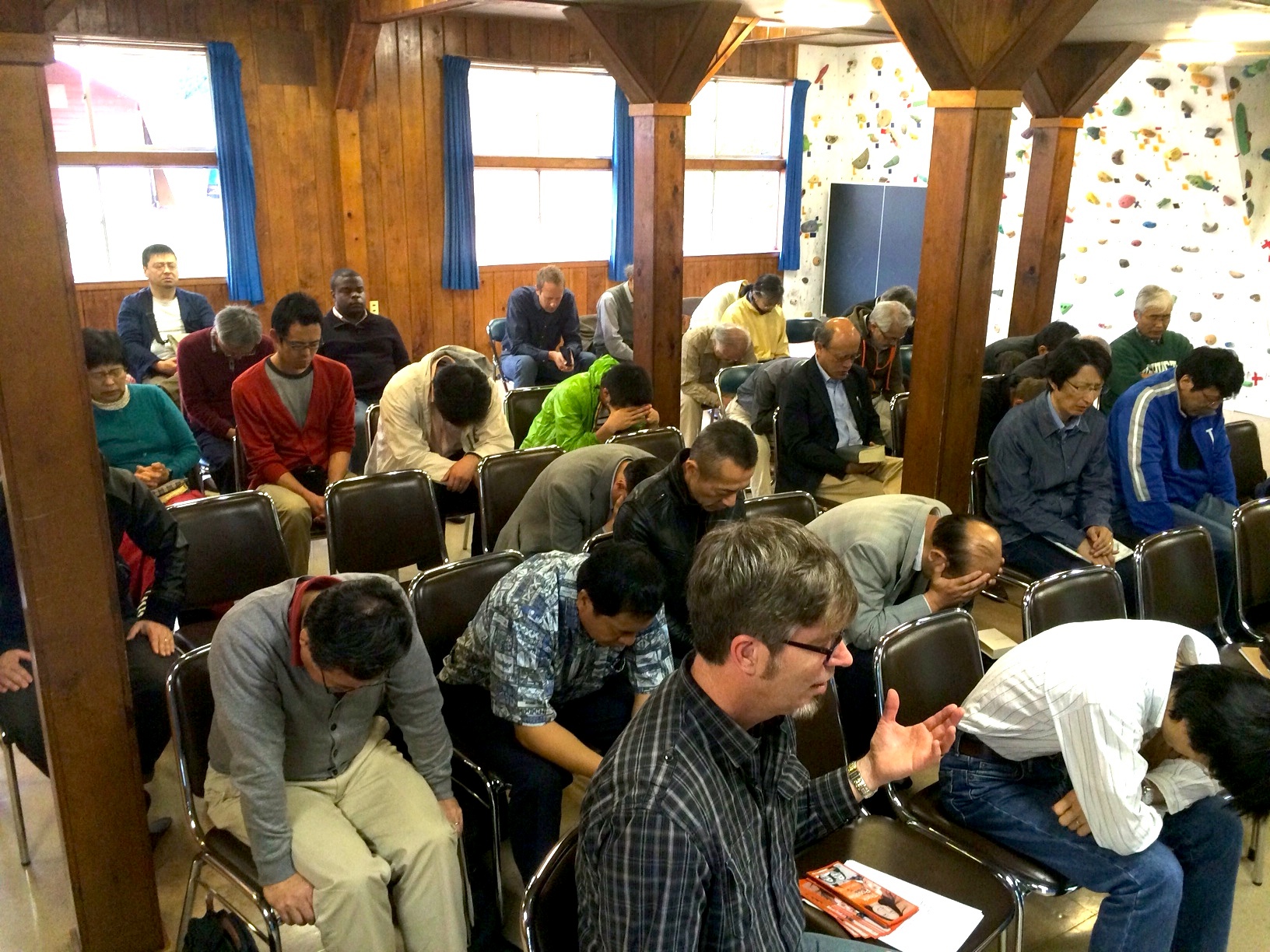
I was challenged anew by our early morning prayer time together. We prayed for Japan. I sat between a pastor weeping and another prostrate on the floor. For hundreds of years, in spite of the sweat of many workers and the blood of many marytrs, the Japanese have only responded in small numbers to the gospel. But we pray and wait. God is working under the surface.
 SOWING
The gospel plant grows best in native soil. So, over the years we've tried to incorporate Japanese culture into our church activities (while being careful to not compromise the gospel message). In this photo, our group of ladies are practicing the art of Japanese writing using Scripture verses. (see photos)For many in this group, it's their first interaction with the Bible! Toward the end of class, our church member (standing in photo) shared a familiar Japanese rhyme used in writing exercises. Few Japanese know that it was created by the underground church (see website) during the martyrdom of the 17th century. The last letters of each line form the hidden acrostic: "Jesus died for me." That discovery brought some startled response from the ladies! Keep praying!
 GROWING
Recently while preaching at my wife's home church in Yamagata, I was struck by this photo on display there. It shows a tiny group of early church members (including my circled in-laws) surrounding the planting missionary, Joe Meeko. Fifty years later this church has multiplied many times over. It's won to Christ, discipled and sent out many, some even to foreign mission fields! And my life story intersects here, too. Without that missionary's evangelistic work, I might not be married to a Chrisitian woman named Kaori!
Mr. Meeko's faith and dedication was huge, but ultimately it was the work of God that brought my Yamagata family to Christ. I pray Denen Grace Chapel will be the same kind of dynamic, multiplying church here in Kawasaki in the years to come. If God chooses bring much fruit from this work, it won't be because of my ability. Make no mistake: "God gives the growth." (1 Cor 3:6)
 REJOICING
Recently on Easter Sunday 2014, I did again what I sometimes do in church. I got out of my front seat and stood in the back. The view from the back is special. Seeing new Christians standing together and worshipping God draws me into deeper worship and thanks, too.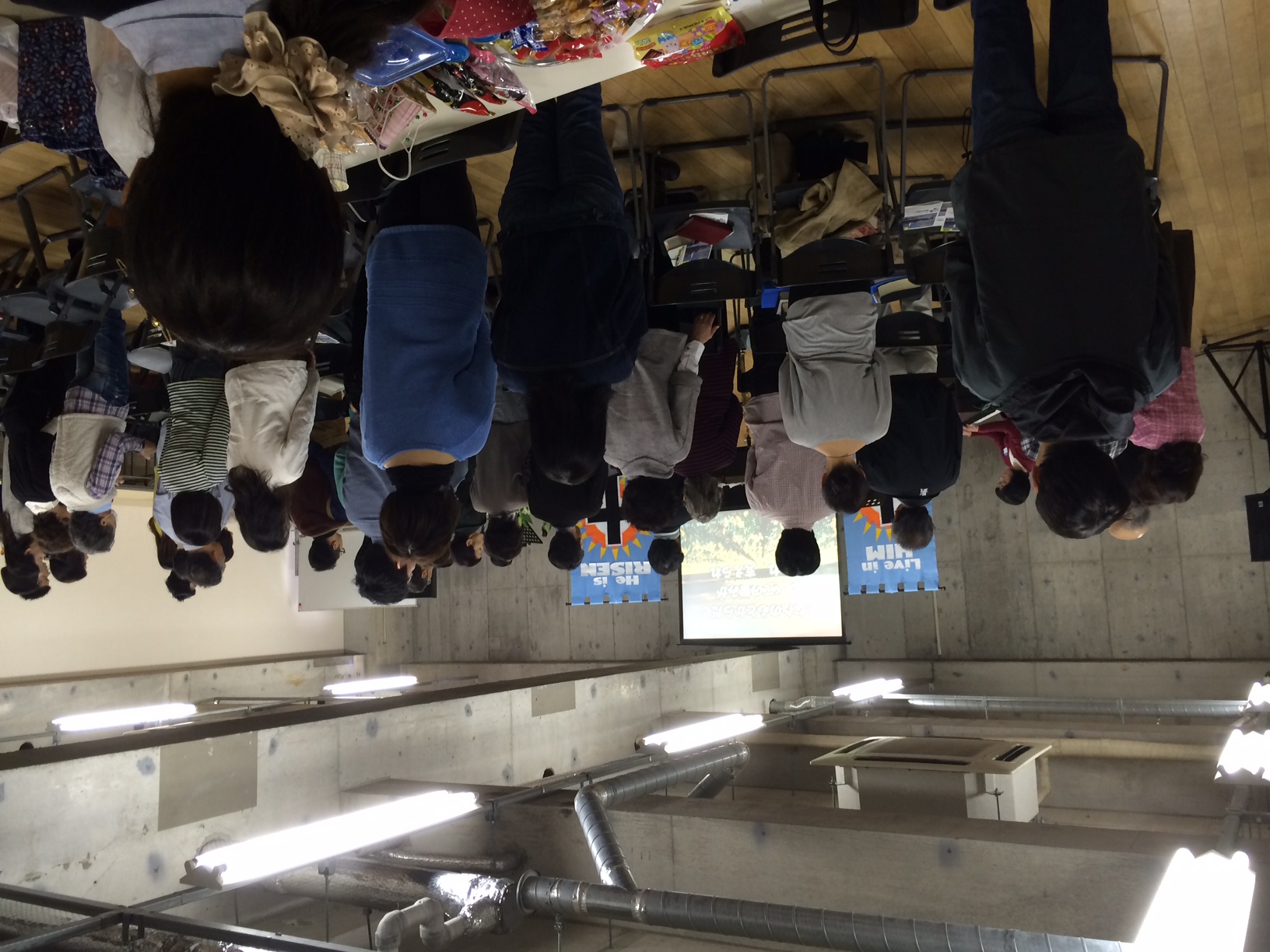
When the week of church planting has been hard, when setbacks seem to outnumber forward motion, when the cultural stress builds up, I like to remind myself of why I'm here. So I go to the back on a Sunday and take a good look. And God tells me, "Always give yourself fully to the work of the Lord [Kevin], because you know that your labor is not in vain." (1 Cor 15:58)
Wednesday, May 28, 2014
The Forgotten Trawler

Imagine you’re aboard a cruise ship. Together with friends, you’re enjoying a time of refreshment and inspiration. You’ve settled into a comfortable cabin. The boat is full of life and activities. You’ve even been asked to help out with things. Food and laughter fill the air. You’ve been sailing the ocean for quite a while, but not sure just where you’re headed.
One morning as you stroll the deck, you notice a large, strange box alongside the railing. Curiosity gets the best of you. You peek inside. Under a layer of dust, you can see coiled ropes and folded nets. For the first time you notice other such boxes all around you. You can just make out the faded letters stenciled on the side: T-A-C-K-L-E. You ask a fellow passenger what this means. He only shrugs. The cabin steward shrugs. But a ship officer seems to remember a story. Before the cabins and carpeting. Before the pools and deck chairs. Once upon a time this ship had a different purpose.
On my desk I have a boat model to remind me of my task in Japan, which is also the task of the church. It’s a fishing trawler with nets on the side ready to drop into the water. You may not have realized it, but when you placed your faith in Christ and stepped aboard the church, you stepped aboard a boat designed to be a fishing trawler. When Jesus said, “Come, follow me and I will make you fishers of men” (Matthew 4:19), that was also your calling to a specific mission of which you are a special part. True, the church could be converted into a cruise ship, but that isn’t the plan of its Builder. Our Builder, Christ, intended us to be about the task of fishing. He’s supplied us with gospel nets of forgiveness, reconciliation, joy, wholeness, and compassion. He’s given us people who know how to this tackle in creative and effective ways. He desires that we work together to go fishing, to draw all kinds of people toward himself.
It’s important that our church sometimes pause and ask the question, “What is it that we’re really doing here?” Very simply, we're casting nets into the ocean of this world and drawing in people toward Christ. We're growing them to be like Him in every way. Christ will steer the fish, but he needs us to let down the nets. As Jesus challenged Peter, he challenges us, “Put out into the deep water and let down your nets for a catch.” Luke 5:4
Church planting is building another fishing trawler. Let’s face it. The amount of fish in Kawasaki (99.5% of 5.2 million people) alone is far beyond what one boat of fishermen can handle. One boat may never catch some types of fish. And one boat alone could never hold them. If a spiritual awakening comes to Japan, what would we do? We need greater capacity! We need new people trained to fish along with us, using their own unique approach, and catching their own unique catch.
Wouldn’t it be great if the church in Japan faced this dilemma of the disciples: “When they had done so, they caught such a large number of fish that their nets began to break. So they signaled their partners in the other boat to come and help them, and they came and filled both boats so full that they began to sink.” Luke 5:6-7
Let’s not forget the purpose we were built. Let’s trust God to bring about a miracle catch. As a missionary family, it is our vision to be sent out from Denen Grace Chapel, to work nearby building another fishing trawler, to be “partners in the other boat” fishing closely in this area together. Would you pray with us? Let’s go fishing!
Wednesday, March 5, 2014
"Think Destination" Corner

Our 6 months in the States is coming to an end. Re-entry is tough. But it always helps with the transition to remember what good things are waiting on the other side of the world, in Japan. Here's my top 10+ favorite things in Japan.
10 Punctual Public transportation
We set our watch to trains that take us comfortably (well, mostly) and quickly anywhere in Tokyo.
9 Amusing etiquette signs in English
Sometimes translation goes a little wrong, strangely, or brashly...and makes me smile.
8 Japanese worship music
Take a listen to a recent contemporary favorite of mine. We also enjoy many western hymns in Japan.
7 Onsen (Hot Springs)
They're all around. If you're not overly shy, onsen can be a great place to relax in God's creation.
6 Prayerwalking
I've learned a lot about my neighborhood and people. And gotten hopelessly lost despite GPS.
5 Mountain climbing
We're surrounded by beautiful mountains. Another father-son climb is in the works for summer.
4 Our neighborhood Denny's
Owned by 7-11. With the call buttons on the table.
3 Gas stations (most are full service)
2~3 attendants hop about checking, washing, filling, stopping traffic for our exit and bowing as we leave. Buying gas never felt so special.
2 Cherry blossoms
They'll be blooming near us shortly after we arrive.
1 No snow to clear, grass to mow, or leaves to rake.
Usually. Truthfully, we miss it...sometimes...not lately.
And the number 1 favorite thing in Japan: Working amongst the people of our church plant (photo). We miss these people at Denen Grace Chapel and look forward to seeing them soon.
Subscribe to:
Posts (Atom)