Showing posts with label History. Show all posts

Monday, September 24, 2012

The Feudal Christian "Rebel"

Juan Goto (1586?) was born Matagoro Iwabuchi, the son of the lord of Fujisawa Castle in northern Higashi-Iwai, Iwate prefecture. He lived during a time of great political instability. His own family was caught up in a power struggle when Great Lord Kasai was accused of not rallying troops for the Battle of Odawara. During this battle, Juan's older brother was killed. This loss, in addition to the political struggles about him, may have contributed to Matagoro's next actions.

Something seems to have snapped in Matagoro that caused him to want to "get away from it all." He fled across country to the far southern city of Nagasaki. This cross-country journey of some 1200 miles was a remarkable feat in itself in his day. From Nagasaki he boarded a vessel that landed him in Ukujima Island of the Goto Islands chain (map). This was as far away as he could get from his homeland and still be in Japan. It reveals, perhaps, a bit of his despair and desperation.

Friday, July 22, 2011

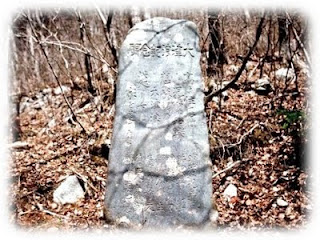
Tsunami Stones

His family perished in the water along with hundreds of others. His beloved town was destroyed beyond recognition. His family home and grave markers were washed away. First the earthquake. Then the waves of water that crushed everything in their path. There was little warning of the tragedy that came ashore that day.

In the midst of his grief, the man desires that generations to come not endure the pain and sorrow that he is going through. They must be warned of the danger of tsunamis! They must not build homes along the shoreline! The man devises a warning system: a marker stone. The year is 1896. The Meiji-Sanriku tsunami has just killed 22,066 Japanese.

Hundreds of these stones are found along the coastline of Japan. Some are more than 600 years old. "High dwellings are the peace and harmony of our descendants,” one reads. "Remember the calamity of the great tsunamis," another stone warns. "Do not build any homes below this point,” an inscription on another stone advises.


In the bustle of modern Japan, many disregarded such good advice, building communities right along water's edge. Perhaps they took comfort in the sea walls built in the 1960's after a smaller tsunami. But in the town of Aneyoshi, a centuries-old stone saved the day. It was advice that a dozen or so households of Aneyoshi listened to carefully, and on March 11, 2011 their homes and lives were spared from a disaster that flattened low-lying towns all around.

A God that loves us infinitely and knows us completely desires that we be spared from personal disaster in this life. He desires that we be spared not from physical death, but from spiritual, emotional and relational death that poor choices and rejection of His ways can bring. His warnings are left for all generations to know and heed. The warnings in His Word are not raging outbursts from an angry God. His warnings are gracious love calls that say, "I am for you. I want you to enjoy everything I have to give you. Listen to my wisdom for your life."

"Today I am giving you a choice between prosperity and disaster, between life and death...Oh, that you would choose life, that you and your descendants might live." Deut. 30:15, 19 NLT

Saturday, April 11, 2009

Way Back When in Japan

Justen and I took the last day of his school spring break to do a little cultural study. A local museum/park/cultural center near our home has an open-air historical Japanese village. You are free to wander about, touch, look and explore Japan as it existed a century ago. What an incredible change this country has gone through in a relatively short period of time in its history as a nation! For Japanese citizens the lifestyle was perhaps quite normal. But I kept on thinking of the rugged change of life that Protestant missionaries from the west were met with. Once in country, there was no turning back like there might be in today's jet age. Missionaries a century ago certainly were met with their share of challenges even before attempting to evangelize in this country.

I noticed a Japanese "manji" on the doorposts of most of the historical houses in this village. I photographed it at right. Most people would associate this with Nazi Germany. Few know that the symbol actually existed centuries before this in Indian and Chinese culture, particularly in Buddhism and other eastern religions. Japan, which imported Buddhism hundreds of years ago, also began displaying the manji as a symbol of peace.

I was reminded that some Japanese homes now display a very different symbol for peace: the cross. My heart is filled with joy for these Japanese families for whom Christ made "peace through his blood, shed on the cross." Yet 99% of Japanese are unaware of this peace. Pray that this new peace symbol will be hung on the heart doors of all Japanese in a nationwide awakening.

Tuesday, March 17, 2009

Protestant Christianity turns 150

This spring marks the 150th anniversary of Protestant Christianity in Japan. The first protestant missionaries set foot in the port of Yokohama back in 1859. Now they were real church planters -- overcoming all kinds of odds. In fact, Christianity was still a proscribed religion in Japan when the first missionaries arrived.

The evangelistic work in Japan during this time often needed to be done discreetly at the initiation of the Japanese seeker. One English missionary wrote in 1869 of the difficulty of accomplishing this. “I read those words (prohibition of Christian preaching), and I realized at once the excessive difficulty of our task. What were we to do? The only opportunity I had was simply to receive the visits of any inquirers who chose to come to me to my own house; and would Japan venture thus? They did venture. Before a month had passed, day by day, hours by hour, my house would be thronged with Japanese visitors….”

In spite of this prohibition, missionary work in Yokohama resulted in a series of revivals, with many converts coming from samurai families belonging to the Shogunate. The most success, however, was realized only after Christianity was granted freedom in the country. This occurred on February 21, 1873 in part as a utilitarian response to encourage trade with the West. The government removed the prohibition of Christianity notices on public bulletin boards for the first time in over 200 years. Now, Christian missionaries were free to evangelize openly. The scope of the missionary work was greatly expanded with the help of national evangelists and pastors including such men as Shinozaki and Honda, who advanced the church in country areas.

Take a look at this photo of one of the earliest Protestant Churches. Can you find missionary Guido Fridolin Verbeck in the middle of the group of new Japanese believers? We missionaries today owe a great debt of gratitude for the stubborn will and faith in God that established the foundations of Christianity in this country! Thank you, Lord, for advancing your church in Japan!